
'%3e%3cpath%20d='M4.02991%2017.5H0.297321V5.81641H4.02991V17.5ZM2.16161%204.22266C0.968304%204.22266%200%203.26172%200%202.10156C0%201.54297%200.229018%201.01172%200.634821%200.617188C1.04062%200.222656%201.59107%200%202.16161%200C2.73214%200%203.28259%200.222656%203.68839%200.617188C4.0942%201.01172%204.32321%201.54688%204.32321%202.10156C4.32321%203.26172%203.35491%204.22266%202.16161%204.22266ZM17.996%2017.5H14.2714V11.8125C14.2714%2010.457%2014.2433%208.71875%2012.3308%208.71875C10.3902%208.71875%2010.0929%2010.1914%2010.0929%2011.7148V17.5H6.36429V5.81641H9.9442V7.41016H9.99643C10.4946%206.49219%2011.7121%205.52344%2013.5281%205.52344C17.3049%205.52344%2018%207.94141%2018%2011.082V17.5H17.996Z'%20fill='white'%20/%3e%3c/g%3e%3cdefs%3e%3cclipPath%20id='clip0_1338_1747'%3e%3crect%20width='18'%20height='20'%20fill='white'%20/%3e%3c/clipPath%3e%3c/defs%3e%3c/svg%3e)

'%3e%3cpath%20d='M14.3517%201.875H17.1883L10.9928%208.75781L18.2812%2018.125H12.5758L8.10396%2012.4453L2.99325%2018.125H0.152623L6.77807%2010.7617L-0.208984%201.875H5.64102L9.67896%207.06641L14.3517%201.875ZM13.3553%2016.4766H14.9263L4.78521%203.4375H3.09771L13.3553%2016.4766Z'%20fill='white'%20/%3e%3c/g%3e%3cdefs%3e%3cclipPath%20id='clip0_1338_1751'%3e%3crect%20width='18'%20height='20'%20fill='white'%20/%3e%3c/clipPath%3e%3c/defs%3e%3c/svg%3e)


TL;DR: With the Aiven platform you can get up to 60% savings while solving this problem! Enter Two-Tower Vectors and multi-modal data.
In the high-stakes world of Online Travel Agencies (OTAs) like Expedia, Hopper, Priceline, and Airbnb, seconds matter. A traveler searching for a "beachfront stay in Hawaii" isn't just looking for a room — they are reacting to weather changes, fluctuating flight prices, and social media trends.
Traditional travel platforms often rely on stale data: yesterday's search history or last week's preferences. To truly compete, travel platforms must pivot to Real-Time Context Engineering. By leveraging Aiven for Apache Kafka® (with Diskless Kafka) and Aiven for OpenSearch®, travel brands can provide instant, hyper-personalized booking experiences while attaining infrastructure cost savings of up to 60%.
What is Real-Time Context Engineering for Travel?
Context engineering is the practice of feeding an AI model the most relevant, up-to-the-minute information alongside a user's prompt. In travel, this means orchestrating data from:
- Current Session: Recent clicks, flight filters, and hotel views.
- External Factors: Real-time flight delays, weather at the destination, or sudden price drops.
- User History: Loyalty status and past booking patterns.
By combining these in real-time, your AI booking agent doesn't just guess — it knows exactly what the traveler needs now.
With multi-modal data, your "Cold Start" solution moves from a smart guess to a high-fidelity visual match. In travel, a picture truly is worth a thousand data points. A brand-new resort with no bookings still has Visual DNA: the blue of the water, the style of the furniture, the layout of the lobby.
By combining Aiven for OpenSearch® and Aiven's Diskless Kafka, you can turn these visual assets into real-time recommendation engines.
The Multi-Modal Two-Tower Design
In a multi-modal setup, your Item Tower becomes a fusion engine. It doesn't just look at text — it "sees" the property.
- The Vision Branch: Uses models like CLIP or ViT to encode hotel photos into vectors. It captures the "vibe" (e.g., minimalist luxury, rustic jungle, neon city-center).
- The Text Branch: Encodes descriptions, amenities, and room types.
- Fusion Layer: Merges these into a single Multi-Modal Hotel Embedding and stores it in Aiven for OpenSearch.
The "Cold Start" Magic
When a new property is onboarded:
- Photos are uploaded.
- The Item Tower generates its vector instantly.
- Even with zero clicks, this hotel now sits in the vector space next to established hotels that "look" and "feel" the same.
Ingesting Multi-Modal Streams via Diskless Kafka
Multi-modal data (especially images and video) is heavy. Handling this at scale for an OTA requires a cost-efficient pipeline.
- The Pipeline: Use Diskless Kafka to stream metadata and image references (URIs). Since Diskless Kafka saves 80% on inter-AZ networking costs, you can afford to stream richer data packets — like image feature maps or temporary binary blobs — without the "cloud tax."
- Real-Time Context: As a traveler hovers over a photo of a "private infinity pool," that visual interaction is streamed through Diskless Kafka to update the User Tower vector in real-time.
Searching the "Shared Latent Space" in OpenSearch
With Aiven for OpenSearch, you perform a Neural Search that bridges modalities.
Use Case: Visual Similarity Re-Ranking
A traveler is looking at a "Warm" (popular) hotel in Maui, but it's sold out for their dates.
- The Query: The system takes the Multi-Modal Vector of the sold-out hotel.
- The Search: OpenSearch finds the 5 nearest neighbors in the vector space.
- The Discovery: It returns a "Cold" (brand-new) property that has an identical architectural style and beach proximity, but plenty of availability.
Wormhole Vectors: Making the Visual "Explainable"
Wormhole vectors are critical for multi-modal data because "visual similarity" can be hard for a user to pin down.
- The Vector Match: The system finds a hotel because its image matches the user's aesthetic.
- The Wormhole Traversal: OpenSearch identifies the tags most common in that visual cluster (e.g., "industrial loft," "exposed brick," "rooftop bar").
- The UX: Instead of a generic "You might like this," your UI says:
"Since you've been looking at industrial-style lofts with rooftop views, check out this brand new opening in Shoreditch."

Operational Workflow
- Ingest: New hotel listings and real-time user clicks flow through Diskless Kafka (saving 80% on data transport).
- Embed: A microservice runs the Two-Tower inference, generating vectors from raw metadata and photos.
- Index: Vectors are pushed into Aiven for OpenSearch.
- Serve: When the user searches, OpenSearch performs a k-NN match. The "Cold" hotel is retrieved because its vector DNA matches the user's intent vector.
Architecture
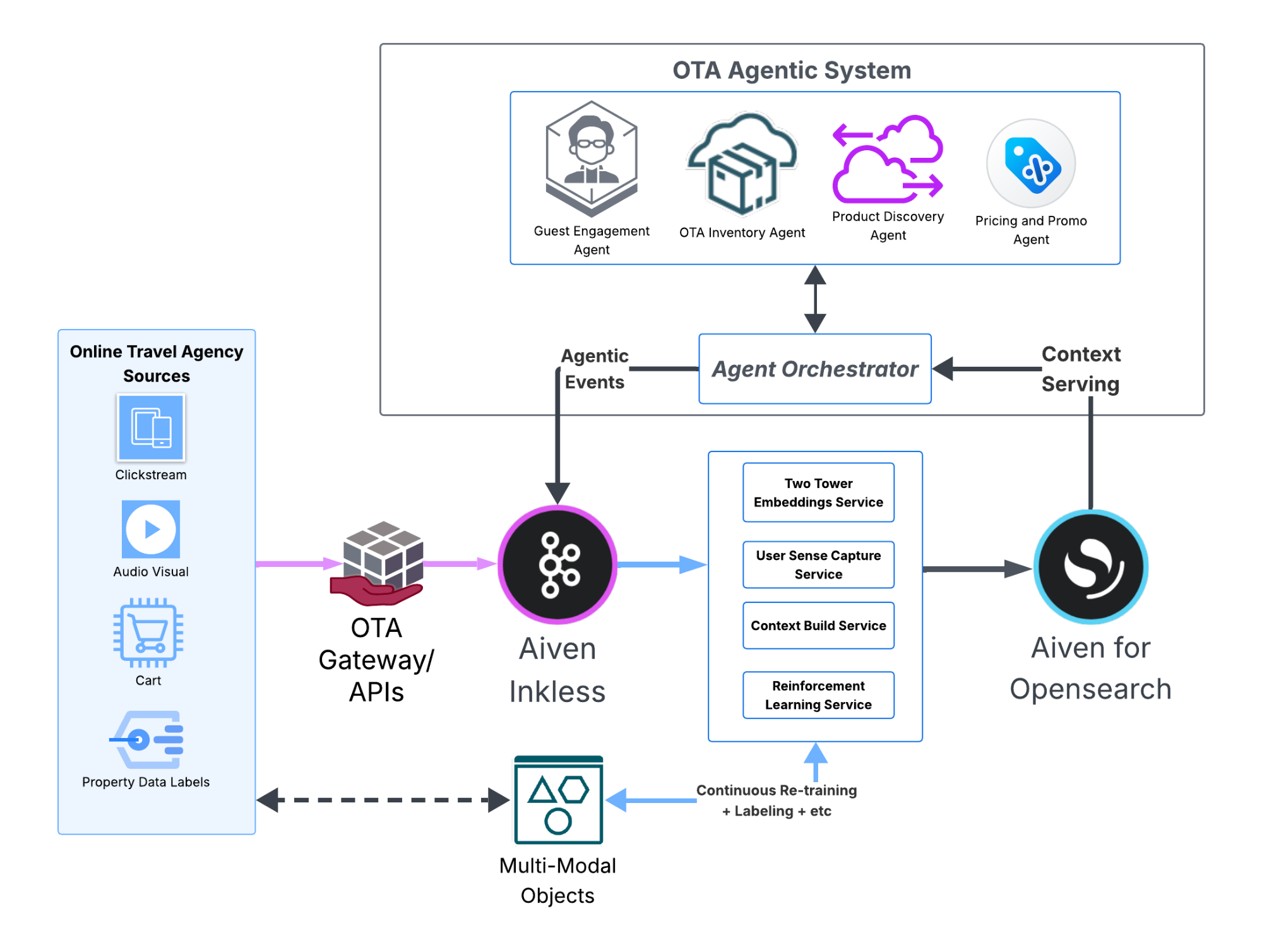
Summary of the Multi-Modal OTA Stack
| Step | Technology/Tool | Process |
|---|---|---|
| Ingest | Diskless Kafka | Streams multi-modal events (clicks + image metadata) cost-effectively. |
| Embed | Two-Tower Model | Fuses image + text into a shared vector space. |
| Index | Aiven for OpenSearch | Stores vectors using k-NN for sub-second retrieval. |
| Discover | Wormhole Logic | Extracts explainable keywords from visual clusters to drive UI copy. |
The Operational Benefit: By hosting this on Aiven, you get a production-ready vector database that handles the heavy lifting of multi-modal indexing, while the Diskless Kafka architecture ensures your scaling costs don't spiral as your image library grows.
Your real-time travel personalization engine is within reach. The technical architecture is set — now it's time to deploy.

Table of contents
- TL;DR: With the Aiven platform you can get up to 60% savings while solving this problem! Enter Two-Tower Vectors and multi-modal data.
- What is Real-Time Context Engineering for Travel?
- The Multi-Modal Two-Tower Design
- The "Cold Start" Magic
- Ingesting Multi-Modal Streams via Diskless Kafka
- Searching the "Shared Latent Space" in OpenSearch
- Use Case: Visual Similarity Re-Ranking
- Wormhole Vectors: Making the Visual "Explainable"
- Operational Workflow
- Architecture
- Summary of the Multi-Modal OTA Stack